

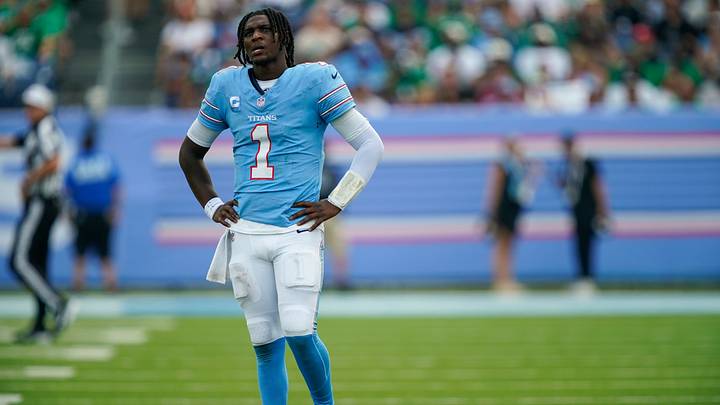
The Tennessee Titans have an offensive problem that shows up before you ever get to passing yards, red-zone numbers or penalties. They are averaging only 22:24 in time of possession through two games, last in the NFL.
The Titans keep giving the ball back too quickly. The defense struggles to get off the field. That has made it nearly impossible for the offense to find any rhythm.
Against the New York Jets, the Titans possessed the ball for only 21:14 and finished with 195 yards. Seven of their nine qualifying offensive drives ended with punts, including four three-and-outs. The Jets made the stat worse with a 19-play drive that lasted nearly 12 minutes.
Titans have a serious time of possession problem
The Titans were much better against the Philadelphia Eagles. Tony Pollard and Tyjae Spears combined for 21 carries and 105 yards, while the offense finished with 291 yards and converted 6-of-13 third downs. The Titans also scored on four of their eight qualifying drives.
Their time of possession still increased by only 2:21, reaching 23:35.
Through two games, 11 of the Titans’ 17 qualifying offensive possessions have ended with punts. Six were three-and-outs. Those numbers are not separate from the possession problem. They help explain it.
Titans' offense improved in Week 2, but the possession problem remains
This is not an offense failing in every area. The Titans have 11 total penalties, with only seven NFL teams committing fewer. They have also scored touchdowns on 60% of their red-zone trips.
Several offensive penalties have come at bad times though. They helped put the Titans in third-and-long situations on four drives. The Titans resorted to kick field goals on two of them, but the added distance made those possessions harder to keep alive.
Time of possession does not belong entirely to the offense, either. The Jets held the ball for 11:48 on one possession. The Eagles had four drives that lasted longer than six minutes. The Titans’ defense has to find ways to get off the field before those possessions wear it down.
In two games, the Titans' opponents have combined to go 16-of-33 on money-down situations, including a perfect conversion rate on fourth down.
Still, the offense controls how quickly it gives the ball back. Tennessee cut its three-and-outs from four in Week 1 to two in Week 2. That is real progress, but more than one-third of its qualifying drives this season have still ended without a first down.
The Titans do not need to fix everything at once. Week 2 showed that the running game can work and the offense can put together scoring drives. Now they have to do it more consistently.
Until those empty possessions become real drives, the clock will keep reflecting the Titans’ biggest offensive problem.
 Add us as a preferred source on Google