

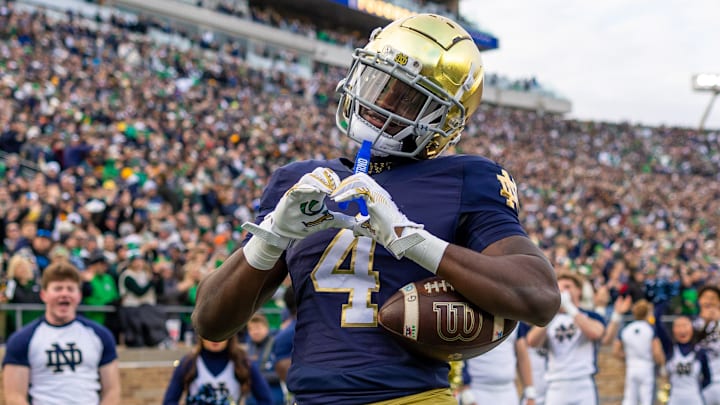
At the time of writing, Jeremiyah Love is considered the favorite to be drafted fourth overall by the Tennessee Titans. Various betting odds suggest that there’s somewhere around a 40-45% chance of Love being the selection, with David Bailey, Reuben Bain, Sonny Styles and Carnell Tate all somewhere between 10 and 25 percent.
With the idea of Love going to the Titans gaining steam, conversations about positional value have been all over the draft community in recent weeks. There are a number of angles to this debate, but it mainly revolves around the question of how much a top running back actually impacts his team.
Of course, highly drafted running backs like Love will affect the game in a variety of ways, but at the end of the day, you would expect the bulk of their impact to come on the ground. So the question is – Does selecting a running back early in the draft usually lead to a significantly improved run game? To answer that, let’s look back at recent instances where a team selected a running back in the top 10 and see how much the running game improved the following year.
History isn't on Jeremiyah Love's side for Titans at No. 4 overall
Over the last 10 drafts, there have been six running backs selected in the top 10. They are: Ashton Jeanty, Bijan Robinson, Saquon Barkley, Leonard Fournette, Christian McCaffrey, and Ezekiel Elliott. Four of them are inarguably elite players. Fournette had a strange career but was clearly a decent player, and Jeanty is still TBD.
However only three of the teams actually saw their EPA per rush increase the year after making that selection. Interestingly, Fournette’s Jaguars had far and away the biggest increase, jumping from 31st in the league all the way to 7th. On average, these six teams improved their league ranking year over year by a little over one spot. Not exactly the overhaul that they might’ve been hoping for.
NFL Team EPA per Rush ranking the year before and after drafting a RB in the top 10 (Since 2016):
— AJ Cola (@AJ_FFball) April 1, 2026
Raiders (Jeanty) - 32nd before, 32nd after (+0)
Falcons (Robinson) - 4th to 28th (-24!!)
Giants (Barkley) - 17th to 11th (+6)
Jaguars (Fournette) - 31st to 7th (+24)
Panthers (CMC)…
The most striking of these examples is the 2023 Falcons. After taking Bijan Robinson with the 8th overall pick, they dropped from 4th in EPA per rush all the way down to 28th. Even as Robinson blossomed into a superstar in the two seasons that followed, the Falcons failed to match their 2022 rushing efficiency, finishing 7th and 20th.
You can debate which of these running backs were worth the draft capital that was spent on them, but the point of this analysis is to demonstrate that a team’s ability to run the ball has much more to do with their offensive line and playcaller than it does the running back.
The Titans should improve on the ground with a few new faces up front and a new playcaller, but recent history tells us that drafting a top running back prospect doesn’t always lead to a more efficient run game, even when that prospect is elite in the NFL. With that in mind, perhaps the Titans would be better served using such a valuable pick elsewhere.
 Add us as a preferred source on Google