

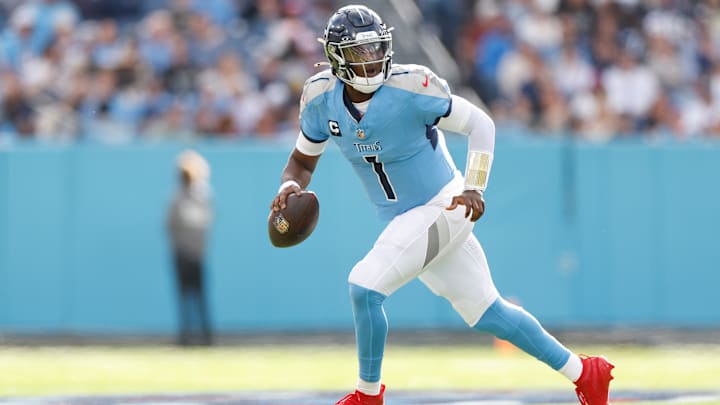
There’s no question that Cam Ward’s rookie season was inconsistent. We saw flashes of the arm talent and escapability that made him such a tantalizing prospect, as well as poor decisions that made some draft analysts a little more skeptical.
Whatever you thought of Ward as a prospect, it’s very clear that he improved over the course of the season. Compare his pre and post bye week metrics, and just about every single one of them moved in the right direction. Just looking at the most basic of stats, Ward's TD/INT ratio was 5-6 in the first half, and 10-1 in the second. If you prefer more advanced metrics, his EPA per dropback went from a league worst -0.206 to -0.023. Still in the bottom 10, but a massive improvement nonetheless.
All of those improvements are great to see, but there’s one stat in particular that Ward flipped on its head in the second half of the season – his pressure to sack rate (P2S%). In other words, the percentage of plays in which you are pressured that result in a sack. As with any stat in football, it’s far from perfect, but it typically does a good job of measuring pocket presence and escapability, especially when it’s looked at in conjunction with time to throw.
Titans QB Cam Ward improved in one key area that highlights his 2026 potential
In the first half of the season, Ward had the highest P2S% in the NFL at 29.7%, according to PFF. For context, here is the list of rookie quarterbacks since 2006 to have a P2S% at least that high: Tommy Devito, Dwayne Haskins, Keith Null. Not a list anybody wants to be on.
Fortunately for Ward, he will not be joining them after a monumental improvement to 16.7% in the back half of the year. This improvement might come as a surprise to some considering how Ward is often characterized. This is also despite the fact that his overall time to throw has increased slightly.
It doesn’t take an expert to understand that taking fewer sacks is a good thing, but Ward’s improvement in this area goes beyond the on-field impact of limiting negative plays. It shows that the game is slowing down for him, and he is starting to get a better sense of what he can and can’t get away with.
Just like every quarterback at this stage of their career, Ward still has a long way to go in his development. However the fact that his best trait from college is really starting to show itself in the NFL is a great sign as he enters an offseason that will start by rehabbing a shoulder injury.
 Add us as a preferred source on Google